Internal parasites are a routine concern in horse care, but parasite control has changed dramatically over the past several decades. For many years, horse owners were taught to deworm every horse on a fixed calendar schedule, often every six to eight weeks, rotating among products. That approach was simple, but it is no longer considered best practice. Today, veterinarians and parasitologists recommend a more targeted program that protects horse health while slowing the development of drug-resistant parasites.
The American Association of Equine Practitioners updated its Internal Parasite Control Guidelines in 2024. The central message is clear: the goal is not to eliminate every parasite from every horse. That is not realistic, and attempting to do so can accelerate the development of anthelmintic resistance. Instead, the goal is to reduce the risk of parasite-related disease, limit pasture contamination, and preserve the effectiveness of deworming medications that still work.
Why old-fashioned deworming programs are a problem
Traditional deworming programs often treated all horses the same, regardless of age, environment, parasite exposure, or fecal egg count. Horses were commonly dewormed at regular intervals throughout the year, and products were rotated to prevent resistance. Unfortunately, this approach can backfire. Repeatedly exposing parasites to dewormers—especially when treatment is unnecessary—creates selection pressure on parasite populations and favors the survival of resistant worms.
The AAEP recommends discontinuing fixed-interval, year-round deworming and discontinuing blind rotation of anthelmintic drug classes. Instead, deworming should be based on the horse’s age, management conditions, season, geographic region, fecal egg count results, and the known drug efficacy on the farm.
This is especially important because no dewormer eliminates all parasite stages in a horse. Even appropriately treated horses may still harbor immature, encysted, migrating, or otherwise protected stages.
The major internal parasites of horses
Several parasite groups may affect equine health, but not all are equally important for every horse or in every region.
Small strongyles, also called cyathostomins, are among the most common parasites in grazing horses. Most adult horses carry small strongyles without showing signs of illness, but under certain circumstances, larvae emerging from the intestinal wall can cause larval cyathostominosis, a serious inflammatory disease of the large intestine. The AAEP notes that strongyles may be less of a primary concern in arid regions or in horses not kept on green pasture.
Large strongyles, especially Strongylus vulgaris, are historically significant because they can migrate through blood vessels and cause severe disease. Intensive deworming programs have greatly reduced large strongyles in many areas of the United States, but concern remains that very low treatment intensity could allow re-emergence in some populations.
Tapeworms, especially Anoplocephala perfoliata, are common in grazing horses and have been linked to certain types of colic, particularly those involving the ileocecal region. However, routine fecal egg counts may miss or underestimate tapeworm infection, so control decisions may require regional risk assessment and veterinary guidance.
Ascarids, or roundworms, are most important in foals, weanlings, and young horses. Heavy ascarid burdens can lead to poor growth, respiratory signs during larval migration, and, in severe cases, small intestinal impaction. Adult horses rarely develop clinical disease from ascarids.
Other parasites, including pinworms, bots, stomach worms, threadworms, and neck threadworms, may also be relevant depending on the horse, region, management system, and clinical signs. For example, pinworms may cause tail rubbing and irritation but are often missed on routine fecal testing because eggs are deposited around the anus rather than shed evenly in the manure.
Fecal egg counts: useful, but often misunderstood
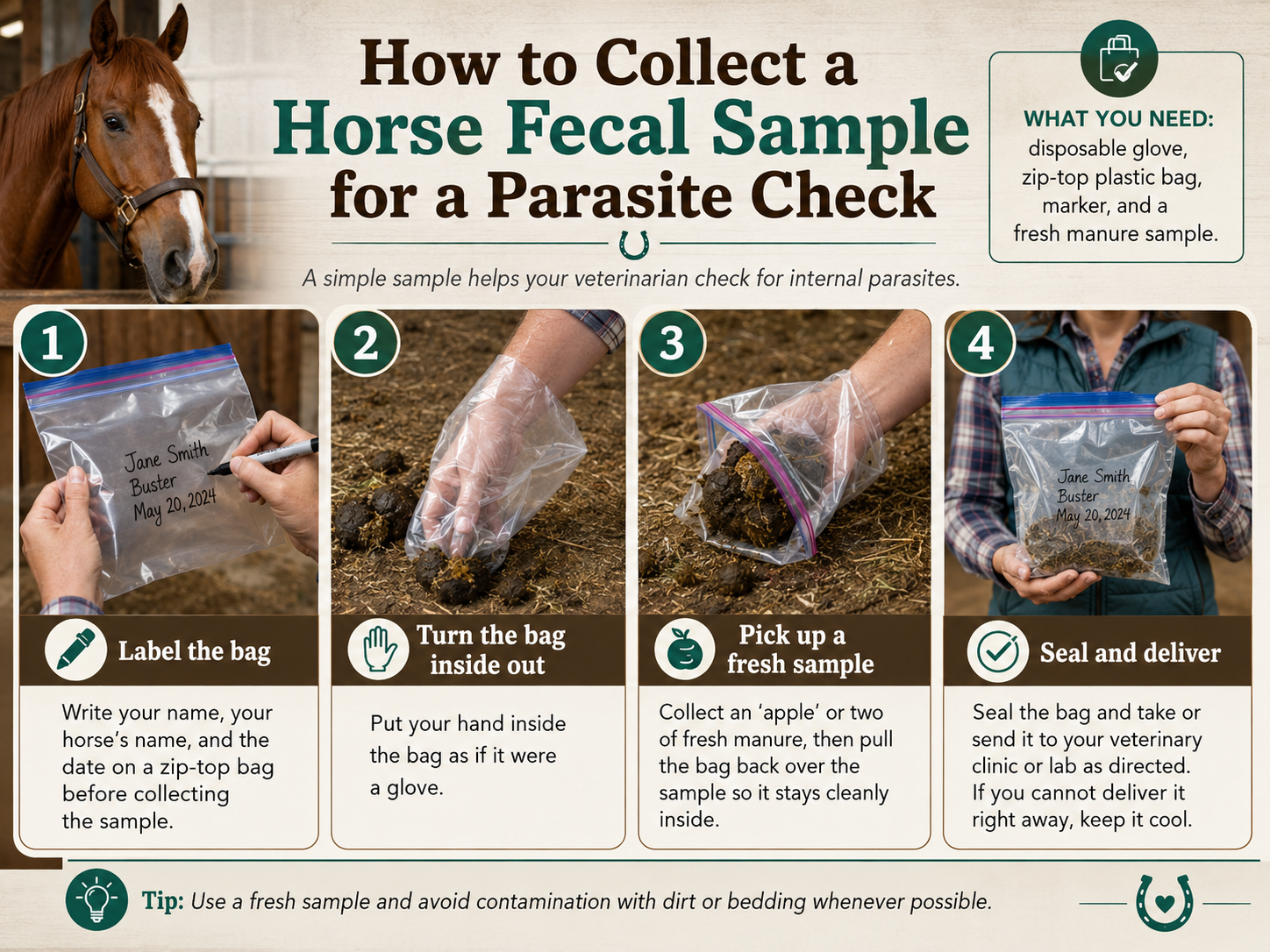
Fecal egg counts (FECs) are among the most important tools in modern parasite control. A fecal egg count estimates how many parasite eggs a horse is shedding in its manure at the time of sampling. In adult horses, this is especially useful for identifying low, moderate, and high strongyle egg shedders.
This matters because parasite egg shedding is unevenly distributed across a herd. In many groups of adult horses, a minority of horses is responsible for most of the strongyle egg contamination on pasture. The AAEP guidelines describe this as the common “20/80 rule,” in which 20% or fewer of horses may contribute about 80% of the egg output.
However, fecal egg counts have limitations. A high fecal egg count does not necessarily mean the horse is sick, and a low count does not guarantee the horse has no parasites. FECs do not detect immature or larval stages, including encysted small strongyles, migrating large strongyles, or migrating ascarids. Standard fecal tests may also miss tapeworms and pinworms. The AAEP emphasizes that FECs should not be used to diagnose parasite disease in a clinically ill horse because egg count magnitude does not reliably correlate with disease-causing parasite stages.
For routine adult horse management, the AAEP recommends continuing fecal egg counts once or twice a year to classify horses as low, medium, or high shedders and to help reduce pasture contamination.
Fecal egg count reduction testing
Knowing which horses shed the most eggs is only part of the program. Horse owners also need to know whether the dewormer used on the property remains effective. That is where the fecal egg count reduction test (FECRT) becomes important.
A fecal egg count reduction test, or FECRT, compares fecal egg counts before and after treatment to estimate how effectively a deworming product reduces egg shedding. The AAEP recommends performing FECRTs annually to ensure the dewormers used in a barn or herd remain effective.
This is increasingly important because resistance is now a practical management problem, not just a theoretical concern. If a product no longer works well on a farm, continuing to use it can create a false sense of security and allow resistant parasites to persist and contaminate the environment.
Baseline deworming plus targeted treatment
A modern parasite control program typically combines baseline treatment with selective treatment. The AAEP recommends deworming all horses at a baseline rate, generally once or twice per year, and then treating selected horses more often based on fecal egg count results, especially adult horses that are strongyle high shedders.
This does not mean low-shedding horses are ignored. Rather, they are managed strategically rather than repeatedly and unnecessarily. High-shedding horses may need additional treatment because they shed more eggs into the environment. Young horses require a different strategy because they are more vulnerable to ascarids and may not yet have developed the same parasite immunity as mature horses.
Senior horses also deserve individualized attention. A healthy senior with good body condition and consistently low fecal egg counts may not need the same program as a thin senior horse with dental disease, metabolic problems, immune compromise, or heavy pasture exposure. The AAEP guidelines provide distinct recommendations for mature, senior, and young horses because age and immunity strongly influence parasite risk.
Management matters as much as medication
Dewormers are only one part of parasite control. Environmental management can reduce parasite exposure and may reduce the need for repeated treatment.
Good practices include removing manure from stalls, dry lots, paddocks, and small pastures; avoiding overcrowding; preventing overgrazing; and feeding hay or grain off the ground when practical. Rotating pastures can help in some systems, although it alone is not a guaranteed method of parasite control. In hot, dry climates, parasite transmission patterns may differ from those in humid, green pasture environments. The AAEP notes that strongyles and tapeworms may be less significant concerns in arid regions or for horses not maintained on green pasture.
Manure management is especially important on small-acreage properties where horses graze near areas of fecal contamination. A carefully designed deworming plan can fail if horses are continually re-exposed to infective larvae in an overstocked environment.
Practical take-home recommendations for horse owners
Horse owners should work with their veterinarian to develop a parasite control program tailored to the farm or stable. A good program usually includes:
1. Fecal egg counts once or twice yearly for adult horses.
2. Annual fecal egg count reduction testing to confirm product effectiveness.
3. Baseline deworming once or twice yearly, with additional treatment for high shedders or higher-risk horses.
4. Special protocols for foals, weanlings, yearlings, and young horses.
5. Consideration of regional risks, climate, pasture access, and stocking density.
6. Manure and pasture management to reduce environmental contamination.
7. Avoid fixed, year-round deworming schedules unless specifically justified by veterinary guidance.
Equine parasite control is no longer about giving the same dewormer tube to every horse every few months. It is about using diagnostics, targeted treatment, and management practices to protect the horse while preserving the medications available to us. The best parasite control program is not the most aggressive—it is the one that is evidence-based, farm-specific, and sustainable.